
The Carpathian Basin
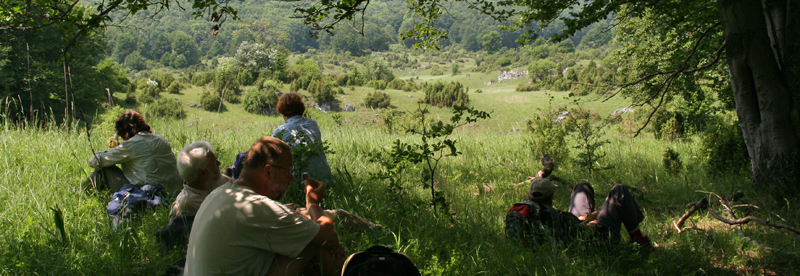
The transition of the Carpathians and the Pannonian Plain is naturally very diverse in landscapes, from mountains to rivers and floodplains and dry, sometimes alkaline, steppe (puszta). In NE hungary this transition is most apparent with the Northern hills, such as the Bukk and Zemplen hills, slowly merge into continental steppe and riverine landscapes. Therefore, one of the main attractions of Hungary is the lie in the Carpatian Basin.
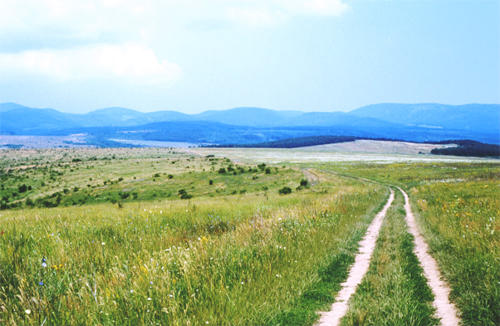
the Bukk Hills merge into lower land
The Carpatian basin, of which Hungary forms the heart, is regarded as a seperate eco-region, due to the unique character of its Flora and Fauna, which in turn is a result of a very interesting geology and of a complex of climatic conditions. This eco-region is called the Pannonian eco-region. Organisms typical for this eco-region are called pannonian elements. In the national parks many of these interesting organisms can be found.
Because of this mozaik of natural habitats and extensively used or properly managed, small scale semi-nature, many species that are rare or extinct in large parts of Western Europe are common here (e.g. Roller, Corn Bunting, Crested Lark etc.).
Because of its climate and geological history, the region has elements of higher mountains (Carpathians), mediterranean and continental regions in it’s Flora and Fauna, exposing a high diversity of organisms, each adapted to different circumstances, but all in close vicinity.
Hungarians tend to protect their valuable natural assets very well. The various habitats are often in pristine condition. In many areas the (original) nature is enriched by a more or less traditional use of the land, such as small scale agriculture, the creation of fish ponds or modern well dosed land management. The National Parks are large, and several very succesfull conservation projects have increased endangered bird populations of species that are rare or even absent in the surrounding countries (e.g. Imperial Eagle, Saker Falcon, Great Bustard).
Most of Hungary’s National Parks or other reserves are located in the Northeast of Hungary.
 English
  Deutsch
  Nederlands